Gratitude is a command with a promise
Scripture doesn't suggest thankfulness; it prescribes it — not because God needs the compliment, but because gratitude re-centers the heart on the Giver.
“Be thankful in all circumstances, for this is God’s will for you who belong to Christ Jesus.”1 Thessalonians 5:18 (NLT)
“Enter his gates with thanksgiving; go into his courts with praise. Give thanks to him and praise his name.”Psalm 100:4 (NLT)
Notice the preposition: thankful in all circumstances — not for all circumstances. Christian gratitude doesn't pretend the hard thing is good; it insists God is present inside it.
How to start a Christian gratitude journal
You can start tonight. You need a place to write, a moment you already keep, and permission to be specific.
- Pick the page. A notebook on the table, or a locked note on your phone. If you want the thanks to sit next to Scripture, Walk With Jesus keeps the entry and answers it with a verse.
- Pick the moment. After coffee, before the first scroll, or once the house is quiet. Same cue each day. The guide on a daily devotional habit shows how to anchor a small practice so it survives a real week.
- Write three lines. One gift, one line that traces it to God, one sentence of thanks. The method is just below.
- Stop. Ninety seconds counts. If the thanks turns into a longer conversation, let it. That is how a gratitude page becomes a prayer journal.
The three-line method
Each day, write three lines:
- Name it. One specific gift from today. Not "family" — "Emma laughing at dinner." Specificity is what makes gratitude land.
- Trace it. One sentence connecting the gift to God, echoing James 1:17 — “Whatever is good and perfect is a gift coming down to us from God our Father” (NLT). Then your own line: “This one came from You too.”
- Thank Him. One sentence of direct thanks, written as prayer: "Thank You, Father, for…"
Ninety seconds, and you've prayed, noticed, and worshiped. Do it at the same anchor point every day — see building a devotional habit for how to make it stick.
Christian gratitude journal examples
These are shapes to copy, not scripts from someone else's life. Fill them with your day.
An ordinary evening. Name it: “The ten quiet minutes before anyone else was up.” Trace it: “This calm came from You too.” Thank Him: “Thank You, Father, for a morning I did not have to earn.”
A hard day. Name it: “A friend texted when I almost canceled everything.” Trace it: “You were near in that message, even though the day stayed heavy.” Thank Him: “Thank You for staying close when I could not see much else.”
Neither entry pretends the day was fine. Both tell the truth about one mercy and address it to God.
Gratitude on the hard days
The three-line method survives bad days because it never asks you to lie. On a hard day, mark the day honestly — in Walk With Jesus you'd pick Down or Struggling, not force a smile — and then hunt for one small mercy inside it: the friend who texted, the rain that finally stopped, the grace that you made it here at all. Gratitude practiced only on good days is a mood. Practiced on hard days, it's faith.
Watch a month of thanks add up
The compounding effect of a gratitude journal appears in review, not in writing. After a few weeks, reread your entries: you're holding a ledger of God's kindness with dates on it.
Your month of gratitude, gathered for you
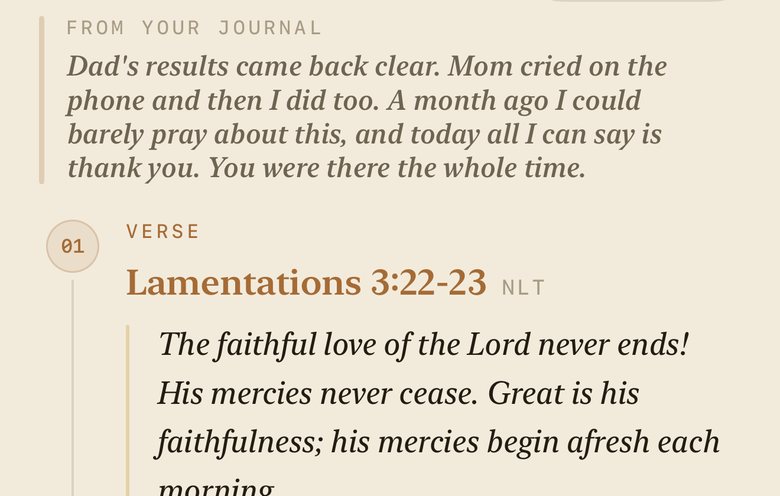
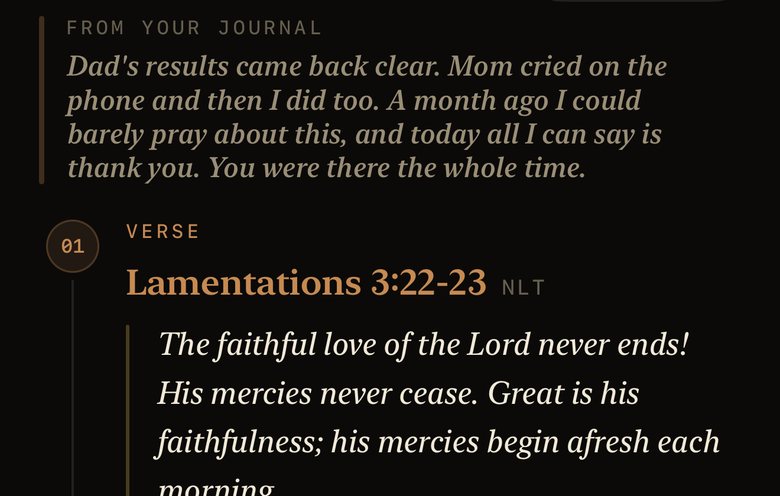
Write your three lines, tag the day's mood, and let Insights assemble the month: days you showed up, your mood ring, words written, and the verse that stayed with you. Verses about thankfulness arrive matched to what you actually wrote — not a generic list.
Verses for a Christian gratitude journal
You do not need a long list. Pray the lines already on this page, then write underneath them.
- 1 Thessalonians 5:18 — thankful in the circumstance, not necessarily for it. Use this on the day you cannot call the pain a gift.
- Psalm 100:4 — thanksgiving is how you come in. Write it as the first line when you do not know how to start.
- James 1:17 — the good thing has a Giver. This is the “trace it” line in the three-line method.
When you want a verse for the feeling under the thanks — weary, glad, anxious — Bible verses for how you feel is the longer shelf. The full quotations above are the ones to pray; this list is only how to use them.
Christian gratitude journal prompts
Use one prompt when the three lines stall. More prompts, beyond gratitude, live in Christian journal prompts.
- What did I eat today that I never once worried about having?
- Who loved me this week in a way I didn't earn?
- What prayer from last year is now an answered fact I've stopped noticing?
- What ability did I use today without thinking (walking, reading, seeing)?
- What made me laugh recently?
- What in nature stopped me this week, even for a second?
- Which hard season eventually produced something I'm now thankful for?
- What do I own that once felt like an impossible luxury?
- Who introduced me to Jesus, or kept pointing me back to Him?
- What about God's character am I most relieved is true today?
How to practice gratitude daily as a Christian
A daily practice is smaller than a perfect routine. Thank God for one specific thing at the same moment each day, using the three lines above. On a hard day, thank Him for His presence in it, not for the pain itself. The aim is to return, not to perform.
That is the short version of how to practice gratitude daily as a Christian: one honest return, tied to a cue you already keep, written to God rather than about your mood. A fuller walk through the week — what to do when thanks feels fake, how to keep it when you travel, how it grows into prayer — belongs in its own guide. Until that page exists, begin here. Three lines are enough to practice today.
Questions about a Christian gratitude journal
What is a Christian gratitude journal?
It is a short record of thanks written to God. You name a real gift, trace it back to Him, and thank Him in a sentence. The point is worship and attention, not a streak of positive thinking.
How do I start if I have never journaled?
Write tonight's three lines and stop. Specific beats general: “the soup was hot” is better than “my family.” Do it again tomorrow at the same cue. You do not need a special notebook.
What do I write on a hard day?
Tell the truth about the day, then name one small mercy inside it. Thank God for His nearness, not for the hardship. Gratitude that only shows up on easy days is a mood. On hard days, it is faith.
How is this different from a prayer journal?
A gratitude journal stays with thanks. A prayer journal also holds requests, questions, and the answers you notice later. Many people keep both in the same notebook. If you want the wider practice, start with how to start a prayer journal.

Three lines of thanks, every day
Free on the App Store. Write your gratitude, mark your mood, and be met with Scripture that fits the day you actually had.
Download on theApp StoreFree download · Private by design · English & Español